Showing posts with label peanut allergy. Show all posts

08 October 2013

Peanut Allergy Treatment Continues To Be Success

Life with a peanut allergy can be scary; however,I have good news. Our son Alexander has been desensitized to his peanut allergy. It is true! Through the use of Food Oral Immunotherapy,
Alexander was treated in 2011 by Dr. Richard Wasserman.
Five years after its inception, this program continues to be successful with over 190 patients desensitized to various food allergies including milk allergy, egg allergy and tree nut allergy.
I welcome you to my blog, Just A Little Peanut for more information.
Click here to read a progress report on Alexander.


Alexander on the day of his 24 Peanut challenge and graduation -2011


Here is an excerpt from the October 7, 2013 issue of the Dallas Allergy Immunology Newsletter 
"Have You Heard?
Food Oral Immunotherapy (OIT) is an emerging treatment for food allergy that is offered
at Dallas Food Allergy Center (DFAC)/Dallas Allergy Immunology.
This treatment desensitizes patients to their allergenic food and at the end of treatment
most patients eat the food on a daily basis. We have offered this treatment for over 5 years now
and 190 DFAC patients are now eating their previously allergenic food!
Food OIT is offered for the treatment of peanut, tree nut, milk, egg, soy, and sesame allergy."

In prior posts we have detailed Alexanders treatment and many other topics. We hope our blog is helpful to you.
Peanut desensitization has been a great blessing for our son and our family. 

To God be the Glory!
-Julie

18 July 2012

Peanut Allergy Treatment plus Milk, Egg, Wheat, Cashew Allergies: All Successfully Treated

Peanut allergy, milk allergy and other food allergies can now be successfully treated!
Dr. Richard Wasserman at Dallas Allergy Immunology (DAI) has been providing Food Oral Immunotherapy (OIT) since 2008 for people allergic to peanuts, milk and eggs.
Over time the OIT program has expanded to treat wheat, tree nut and soy allergies.

My son Alexander has been successfully desensitized to peanuts. This blog documents every phase of his treatment.
Alexander "graduated" in 2011 and eats a maintenance dose of 8 peanuts per day.

According to the DAI Quarterly Newsletter published July 2012:
"DAI has a number of children who have graduated from our Food OIT program and are now eating eggs, peanuts, cashews, pecans and wheat or drinking milk without reactions"

"This program is designed for a child of school age or older who will be old enough to understand the reasons for participating and be actively engaged in the process."


Below are the current Oral Immunotherapy treatment statistics from DAI's June newsletter.
Patients who have graduated or "completed" the program are considered desensitized to their particular food allergy.

"From 2008 to present:
Egg
27 complete, 3 active

Milk
39 complete, 16 active

Peanut
81 complete, 26 active

Cashew
1 complete, 1 active

Wheat 
3 complete 0 active

Pecan
0 complete, 1 active"

This program has provided Alexander both physical and mental relief. Allergies to peanuts, tree nuts and a few other foods can be deadly. Food allergies in general can be very debilitating.

For more information see:
Peanut Allergic Teenager Eats a Peanut

Milk Allergy Treatment 

Peanut and Food Allergy Testing Results for Alexander Over the Years

Precise Dose for Peanut Oral Immunotherapy Treatment

Peanut Allergic Teen Officially Desensitized to Peanuts


12 March 2012

Peanut Allergy Patch

Is there a Skin Patch for Peanut Allergies? Wouldn't that be grand. Something like a medicine skin patch for sea sickness. It is not so far fetched as you might think.


The good news is that two French pediatricians have developed a skin patch for peanut allergy.
Dr. Pierre-Henri Benhamou told the Daily Mail: "We envisage that the patch would be worn daily for several years and would slowly reduce the severity of accidental exposure to peanuts. " 'The beauty of the patch is that it is absorbed just under the skin and is taken up by the immune system."
"But because it doesn't go directly into the bloodstream there is no risk of a severe reaction.”

The doctor also stated he and his colleague have already conducted a few safety trials. Their next steps will be to conduct trials to establish the size of the dose needed and the amount of time the patch would need to be worn. Read more at Mail Online

In June 2010, the U.S. Food and Drug Administration approved an application that allowed DBV Technologies, a private French company that specializes in food allergies, to begin conducting clinical trials on a new “Peanut patch” called Viaskin. 
Researchers at National Jewish Health are also testing the peanut patch with hopes that clinical trials will commence.


The peanut patch would work in a similar way to the Oral Immunotherapy treatment (OIT) used to desensitize my son Alexander to his peanut allergy. 
Yes my son is desensitized and doing well.  
His entire treatment journey is explained in detail on my blog Just A Little Peanut.
See my posts "Peanut,Milk, Egg Allergy Treatment Explained" and Peanut Allergic Teen Desensitized to Peanuts:Progress ReportYou can follow us on TWITTER http://twitter.com/PeanutBlog
For updates and the latest information can subscribe by Email to this blog- top right section

How does a medicine skin patch work? 
A patch is placed on your skin like a bandaid. The patch contains medicine which is slowly absorbed through the skin. How convenient!
The peanut patch slowly releases minute doses of peanut oil under the skin. The amounts are increased over time to hopefully desensitize the patient the allergy.

Alexander my peanut allergy teen recently used a medicine patch on his knee, prescribed by his phyical therapist.
An increasing number of medicines are now available in the convenient form of a patch. Medicine patches are currently being used to treat the following ailments:
Anti-inflammatories. Pain, Nicotine, Hormone Replacement Therapy, Anti-depressants, Sea Sickness, Alzheimers, Parkinsons (and many more).


If the peanut patch clinical trials prove safe and viable, it is unknown how long it will take before the patch is available for patients. I suspect this type of immunotherapy might be the wave of the future.

Sources:
Daily Mail http://www.dailymail.co.uk/health/article-1392034/Doctors-invent-patch-cure-deadly-peanut-allergy.html
Physorg.com http://www.physorg.com/news/2011-03-peanut-allergy-patch.html

03 December 2011

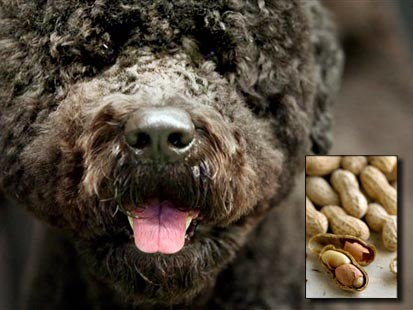
Peanut Sniffing DOGS Detects DANGER for the Peanut Allergic

Peanut sniffing dogs help people with peanut allergies. Yes it is true.
What is a "peanut sniffing dog"? How does a dog help someone with a peanut allergy?
Specially trained dogs are now being used to detect trace amounts of peanuts and other life-threatening allergens.

Sherry Mers whose daughter has a severe peanut allergy started a non-profit foundation, Angel Service Dogs Inc, as a ministry so children with 
"hidden disabilities" such as severe allergies and seizures can afford specially trained dogs or animals to help them. These dogs are expensive.
According to their Website, "Angel Service Dogs, Inc., a 501-C-3, is devoted to placing Allergy Alert Dogsspecially trained 
for peanut, tree nut, and allergen detection, with individuals and families who are inhibited by life-threatening allergies."

Training a peanut allergy dog to detect peanuts is similar to the training a drug sniffing dog receives.
In reviewing their website- here is what I found out.
Allergy Alert Service Dogs are trained to detect a specific set of allergens and to alert their handler of the presence of those allergens.
Angel Service Dogs states that their dogs can protect against contact or ingestion of these life-threatening allergens


Their dogs are trained by Master Scent trainers. These trainers have decades of experience working with scent dogs and working specifically with Allergy Alert dogs.
Dogs are carefully selected for the Allergy Alert dog program.
I found it interesting to learn which breed of dogs are used in the program.  They include Australian Labradoodles, Portuguese Water Dogs and other allergy friendly breeds. 
Click here to visit their website. For information on another breeder of Peanut Detector Dogs click Peanut Dogs
What a wonderful idea! 

In my research I also found a story about a black Labrador Retriever trained to sniff out the most miniscule traces of peanut -- she can even tell whether a chicken nugget has been fried in peanut oil.
I find that truly amazing! As a fairly experienced cook I don't think I could detect exactly what type of oil was used to fry chicken. Seriously!


The dog sniffs down everything and everyone that his owner may come into contact with letting he and his Mom know where it's safe to go or alerting them when peanut traces have been found. 
Watch this video.


Watch CBS News Videos Online

Last but not least take a look at the video below for an MSNBC story on Peanut sniffing dogs. 

Thanks to these specially trained dogs (trained by Angel Service Dogs and other breeders) 
and their unique ability to detect traces of food allergens such as peanuts and tree nuts, the allergic children and adults they service can be safe to live a more normal life.

Angel Service Dog's company slogan sums it up- "life is better with someone watching over you".
Of course in this case that "someone" is a specially trained 4-legged friend.


I hope this story is helpful to you. Please share this story on Facebook or directly with friends you know who have the hidden disability of an Anaphylactic peanut or food allergy.

24 October 2011

PEANUT ALLERGY TREATMENT - INTERNATIONAL PROBLEM with WORLDWIDE INTEREST

Peanut allergies and food allergies are an International concern. They know no borders. 
It's one world  where the effects of living with food allergies cross all boundaries. 
Food allergic individuals and parents of food allergic kids worldwide are desperately seeking help for their children or themselves. 
For more information read my post "Peanut and Food Allergies". 


Since launching my blog last year I have been surprised by the International composition of my audience and their ability to find to my rather obscure blog.
As of today this blog has received visitors from over 67 countries which are listed at the end of this post.
The international scope of interest in peanut allergy and food allergy problems is evidenced by the diverse audience that has read this blog. 
Although I have not fully kept track of every visitor's country,the geographic dispersion of the audience is fascinating.
The audience is from 6 Continents and such diverse cultures as Greenland, Australia, Brazil, China, Germany, Nepal, Nigeria, New Zealand and Qatar. It is an intriguing list.

Thus far the majority of my posts have been about the dreaded peanut allergy
Why?  The answer is simple. 
My son Alexander is undergoing treatment for his life-threatening allergy to peanuts.
The new treatment is cutting-edge and very successful thus far. 
Currently Alexander is in the "maintenance phase" of treatment. He is officially "desensitized" to peanuts. 
Alexander ingests 8 peanuts per day (unless he forgets- scary but true). Thus far there are been no reactions or complications. 
Explore my blog to read the entire story. 
It is truly an amazing experience to see my son eat peanuts. Due to the life-threatening nature of his allergy we are used to altering our lives to strictly avoid peanuts. 
Stories abound about the lifestyle changes that must occur in order to survive life with a dangerous food allergy.

So I write this blog to help others with peanut and food allergies and to spread the good news that real treatment is finally available for Peanut, Milk, Egg and Wheat allergies. Click here for more information. 
Yesaccess to treatment is currently limited unless people have the determination, time and resources to travel to the few places offering a treatment program or clinical trial. 
Research is ongoing and there are new treatments on the horizon for peanut allergies. Subscribe my email to be notified of future posts.

67 Countries - as of 10/24/11
United States  
Argentina
Armenia
Australia
Austria
Belgium
Bosnia-Herzegovina
Brazil
Canada
Chile
China
Colombia
Croatia
Dominican Republic
Ecuador
Egypt
Finland
France
Germany
Greece
Greenland   (57,564 pop.)
Hong Kong
Hungary
India
Indonesia
Iran
Iraq
Iceland
Ireland
Israel
Japan
Kuwait
Latvia
Lithuania  (newest country on the list)
Malaysia
Mexico
Moldova 
Mozambique
Nepal
Netherlands
New Zealand
Nigeria
Norway
Pakistan
Peru
Philippines
Poland
Quatar
Romania
Russia
Saudi Arabia
Singapore
Slovakia
Slovenia
South Africa
South Korea
Spain
Suriname
Sweden
Switzerland
Taiwan
Thailand
Ukraine
Uruguay
United Arab Emirates
United Kingdom
Vietnam


TOP 10 COUNTRIES- (in order of highest number of page views) are:
United States, Canada, United Kingdom, Australia, Romania, India, Phillippines, Germany, New Zealand and France


05 August 2011

Peanut Allergic Teen Officially DESENSITIZED to PEANUTS

On April 12,2011 my son Alexander, who is deathly allergic to peanuts, was officially declared "DESENSITIZED". 


The term sounds like a condition out of a science fiction movie void of feeling and sterile. 
It actually befits our situation as Alexander experienced No Reaction to the ingestion of peanuts during the entire OIT process.


So you may ask "how did we achieve this?" Dr. Wasserman and his staff, especially Angela Galucci,P.A. are the medical heroes making history with their Oral Immunotherapy program.
Our part was being a willing and dedicated participant in the Dallas Allergy Immunology oral immunotherapy program (OIT) for peanuts.


It is important to note that Dr.Wasserman also offers OIT for milk, wheat and egg allergies.
It is surprising the talk to other patients and discover that many peanut allergic people are also allergic to one or more of these other food allergies.


Alexander was not only brave to agree to ingest peanuts to which he is deathly allergic 
(you should read his testing results in a previous post)
but he followed all the rules and requirements with little complaint other than cringing at the mere thought of having to take his distasteful dose.
Yes he also mastered the art of delay when it came to taking his dose. I've heard many funny stories from other patients whose children have taken the slow-playing of dose taking to a new creative high.


As for our journey since April 12th with Alexander's " maintenance dose" of peanuts, I will write a future post on his progress.


I want to thank Dr.Wasserman and his staff for all of their encouragement, candor and support. 


This program is a real breakthrough for everyone who suffers from the dreaded peanut allergy.
I implore you to investigate this program for yourself.  
Read past posts and comments and do your own research. 
Helpful links are on the right side of my blog.


As an expression of our joy and excitement for becoming "desensitized to peanuts" we want to express our prayerful thanks to God our Father for his many blessings 
and
as we say in Texas "yeehaw".

19 March 2011

Lupine Allergy. A Danger for the Peanut Allergic traveling To Europe

Lupine allergy and peanut allergy- is there a link?
On my page "Where Is the Peanut Hiding?"   I list items that pose a hidden danger to people allergic to peanuts. A rather obscure food called Lupin is quickly becoming a more commonly used ingredient and food, especially in Europe and the Mediterranean region.  
(also Australia, USA, Canada, South America,)
WARNING- Unfortunately many peanut allergic individuals can have an allergic reaction to lupin.

What is Lupin?
Lupinus, commonly called lupine in the U.S. or lupin in Europe and Australia, is a common garden plant genus in the legume family, related to legumes such as peanuts,lentils,beans and peas. There are many different types of lupin. The majority of lupin is used for animal feed. "Sweet lupine" varieties are used in foods.


Some lupin varieties produce seeds which are used in foods.
Lupin seed are high in protein and have the full range of essential amino acids.

Lupin in Food
Lupin Flour 
In many mainland European countries, particularly Italy and France, lupin flour and /or peanut flour may be mixed with Wheat flour in baked goods and pasta. Common uses include bread, pizza, pasta, cookies, cereals, gluten-free products, biscuits, onion rings, tomato sauce, chicken bouillon cubes

Soy Alternative  
Lupin seeds are being recognized as a cheaper alternative to soy, becoming a more popular replacement for soy in recipes and other products. 


Fat Replacement in Food  

Lupine may be added to food as a fat replacement. (U.S. manufacturers will love this).  Researchers in Europe have found new uses for Lupin in low-fat products. 
Think low-fat sausage, low-fat ice cream, cream cheese and low-fat baked goods.


Lupini Beans
In the Mediterranean the yellow legume seed of lupins are called lupini beans.
Popular since Roman times, these beans are often soaked in brine and sold in jars like pickles. They are often eaten as a snack. Cento, an Italian manufacturer sells jars of Lupini Beans. You can find them right here in the United States.  Lupini Beans are very popular in Italy
- of course that is where we will be traveling with our peanut allergic son this summer. 
You can buy a paper cone of lupini beans from a street vendor in Rome.

Lupini Beans are popular as appetizers in many countries including Egypt, Syria. Called "altramuz" in Spain and Argentina and in Italy and Portugal called "tremoços"
Tremocos or Lupini Beans
Lebanon call "termos". Turkey and Egypt call "tirmis".
Tirmis sold by street vendor in Egypt
Restaurants
Lupini Beans are incorporated into foods served in restaurants in many countries.
They are used in Soups, Stews, Salads, and Entrees plus Hummus where lupine beans can replace chick peas.
Germany
Newly bred variants of "sweet lupins" are widely grown in Germany. The seeds are used in sausages, lupi-tofu and lupin flour. 

Gluten-Free Products
Although mostly unknown by American consumers, lupin is used in the U.S. in many gluten-free and high-protein products. It is not widely used in the U.K.

Lupin Fiber used in South America
Extracted from the grain shell of lupin and used in South American for cereal bars,sausages,bakery products, food supplements and extruded products

Lupin may cause an allergic reaction if you have a peanut allergy ranging from Hives to anaphylactic reactions.


TRAVELING TO EUROPE- 
We are traveling to Italy and France this summer. What should I do in order to protect my son? 
We do not know if he is allergic to lupin.  I feel I should have him tested, but "where o where" will I ever find the so far obscure lupini bean in the U.S. much less in Texas. Seriously!
I went into "protective parent" mode and did my research to find lupini beans locally.  I felt in had seen them somewhere....I had the picture of a jar in my head.
YES- success!  Central Market, to their surprise, carries them. I will hop in the car today to purchase them.
Food labeling rules in the EU require pre-packed food sold in the UK or the rest of the European Union (EU) to show clearly on the label if  a product contains lupin (or if one of its ingredients contains it). Lupin has been approved for use in bread flour in Europe since 1997.
Thus I think we will be able to avoid the danger of "packaged food" by reading the labels.

If Alexander proves to be allergic to lupin, the big problem for us will probably be restaurant food and their use of lupini beans or lupin containing foods such a bread and pasta.  Even tomato sauce can contain lupine flour. Ugh!

Plan of Action?
1) See if  our allergist can test our son for an allergy to lupine.
2) See if the jarred of lupini beans will work or if I have to source the raw beans.  I have read online about the difficulty in soaking and cooking these beans so I do hope I won't have to be "chef mom".
3) Order Select Wisely food allergy translation cards for use on our European holiday.

HELP -I have many Europeans who read this blog. I need your help. If you know of foods that contain lupine please tell me using the Comment box below.
Thank you so very much- Julie

Sources  http://www.lupins.org/lupins/
Food Standards Agency http://www.food.gov.uk/ , http://www.fraunhofer.de/en/press/research-news/2010-2011/13/low-fat-lupin-proteins.jsp, http://onlinelibrary.wiley.com/doi/10.1002/mnfr.200900365/abstract
http://www.vilher.com.mx/en/productos.php?categoria_id=6&producto_id=53
http://www.hort.purdue.edu/newcrop/afcm/lupine.html

14 March 2011

Life Threatening Food Allergies-This video could save a life. Carry an EPIPEN

So many people do not take food allergies seriously. Although food labeling laws in the U.S. have improved accidental exposure and ingestion of life-threatening foods is common.
The U.S. Food and Drug Administration (FDA) requires food manufacturers 
to list the 8 most common ingredients that trigger food allergies. Most other developed countries have similar rules.
The 8 foods, listed below, account for 90% of allergic reactions.
Milk
Eggs
Peanuts
Tree Nuts such as almonds,cashews,pecans, walnuts)
Fish
Shellfish (especially crustaceans)
Soy
Wheat


The deadliest food allergy is to PEANUTS. It is the most common cause of anaphylaxis death in the United States
(see my list Where is the Peanut Hiding)


What is anaphylaxis?
According to Web MD anaphylaxis refers to a rapidly developing and serious allergic reactions that affects a number of different areas of the body at one time.
It can occur after eating only a tiny amount of an allergic food.
The reaction could start with itchy gums or tingling lips, watery eyes, zoning out, shortness of breath, difficulty breathing, hives or it can be delayed, slower with the person experience the feeling of "impending doom". (not sure how to describe this one).
In the future I will write a more extensive post on experiencing anaphylaxis.

Severe anaphylactic reactions can be fatal.
Those who have a severe peanut allergy are at risk of having a life-threatening reaction and should strictly avoid peanuts and carry an EpiPen epinephrine auto injector at all times according to multiple web sources as well as allergists. 
My teenage son is allergic to peanuts. Our family policy is to carry 2 EpiPen's. 
Those are the instructions for my son to adhere to although he loathes carrying an EpiPen and has forgotten to carry one more often than I can remember.
Why carry 2?
You may need a 2nd dose,often after 20 minutes or less. (Video link @ end of post)

Thank goodness there is hope for those with Peanut, Milk, Egg and Wheat allergies.

A new TREATMENT is now available. 
My son, Alexander is currently being treated successfully
As of the date of this post he is EATING 12 Peanut Per Day. This is his dosing amount as part of his peanut allergy Treatment Program.


So many precious children and adults have died from a severe allergic reaction to food. It breaks my heart. That is why I am writing this blog. 
I want to get the word out about this new treatment program to everyone, along with all this other food allergy information I can post.

Please send a link to our blog Just A Little Peanut. Pass along to as many people as you can think of 
because 
you don't know who your friends may know with life-threatening food allergies. Think outside the box. The information is useful to people worldwide.
I know of one family planning to move from India to Dallas so their daughter can be treated for her peanut allergy.

Alexander's story and Treatment program is detailed in my blog. 
Click here to go to my Home page where you can perform a search using the word Alexander or click on the titles below for a few of the posts.
Countdown to the BIg Day , Treatment Day 1Peanut Allergy Treatment #3 and #4Countdown to 1 Whole Peanut,  Dose Delayed, Allergic Teen EATS a PEANUT 

Remember you could save a life. Please pass this post via FB, Twitter
Too many people have died due to food allergy to peanuts, tree nuts and other life-threatening food allergies. 


Click here to watch a VIDEO on HOW TO USE AN EPIPEN .


Sources- Mayo Clinic , EpiPen, AllergicChild

10 March 2011

Food Allergies Can Be DEADLY- Make A DIFFERENCE During Food Allergy Awareness Week

Food Allergy Awareness Week (FAAW) is coming May 8-14, 2011. There are many things each of us can do to promote awareness of food allergies. Click on the link above to read all about it. 
You can also follow us on twitter http://www.twitter.com/PeanutBlog 


You can have an impact. Request a proclamation from your state governor. Texas is the only state so far to formally recognize FAAW this year. You can "Like" FAAN on Facebook. 
You could contact local media with this press release from FAAN.
There are lots of ideas on their website.  Below is their cute new video for FAAW.
Why is this important to me?
My son has a severe peanut allergy. The good news is he is being TREATED with success using oral immunotherapy. We began treatment in December 2010 and as of this week he is eating 12 peanuts a day. Click here to read an explanation. Also treated are Milk, Egg and Wheat allergies.


07 March 2011

MILK ALLERGY TREATMENT NOW AVAILABLE

Milk Allergy Treatment is now Available. Read one mother's story.
On December 2,2010 Ann Pask and her son Eric began a new treatment, oral immunotherapy, for Eric's severe MILK Allergy. My son Alexander began treatment for his life threatening PEANUT Allergy at the same time. Click here to view my post regarding Treatment Day 1. You van follow us on twitter
www.twitter.com/PeanutBlog

Ann is my first guest contributor. Here is her story, thus far.

Julie:
Well, the sleet is pelting down on the skylight in our master bathroom, and I can’t sleep.  So, thought I’d spend a few minutes thinking about milk allergies!  So, here goes!
-Ann

MILK ALLERGIES

My 10-year-old son, Eric, has life-threatening food allergies to milk, eggs, fish and shellfish.  Prior to his birth, I was blissfully unaware of the impact food allergies could have on a child and the family.  My daughter Rachel, now 13, thankfully does not have any food allergies.  I remember cautiously giving her peanut butter as a toddler, and asking her Mother’s Day Out teacher if any child had a peanut allergy before packing a PB&J.  I also remember the joy of eating ice cream and pizza with her (now forbidden foods), and even the first time she ate mussels when she was about 18 months old.  Then along came my son.

MILK DESENSITIZATION

According to the Food Allergy & Anaphylaxis Network, about 80 percent of children outgrow milk allergy by age 16.  But my son’s blood test scores increased every year, and we feared he might be in the minority that didn’t outgrow the allergy.  I would have dreams (nightmares really) that I had to bake his milk-free, egg-free wedding cake!  That’s why we chose to try milk desensitization.  Eric has been the only child in school who can’t eat pizza for so long, and I want him to at least be able to eat pizza in high school or college!

We began his milk desensitization on December 2, 2010.  It started with an 8-hour day at the allergist’s office.  There were 3 boys starting desensitization that day.  Eric was starting milk, a 15-year-old boy was starting peanut, and a 17-year-old boy was starting egg.  They had name tags that read “milk,” “egg,” and “peanut,” which I found humorous!
Over the course of the day, Eric ingested minute amounts of cow’s milk in a solution of 1 part milk and 29 parts water.  They boys received their “dose” every 15 minutes, until 26 total doses were given.  I’m not sure how much milk he actually got by the end of the day, but I know it wasn’t much.  But thankfully, he did not have a reaction.  At one point, he got nervous so we slowed down a little bit, but overall it went very smoothly.

Since that initial day, we have gone back to the allergist once a week to increase the dose.  The first several weeks, he drank the water/milk solution.  But by the 6th week, I was asked to purchase straight whole organic cow’s milk — something I thought I would never do for my son!  He was given 1 milliliter of cow’s milk, and all went smoothly.  The dose increases have gone as follows:  1 ml, 2 ml, 3 ml, 4 ml, 6 ml, and we just started 8 ml (about 1 1/2 teaspoon).  We have had a couple of incidents, but not too serious.  The first reaction occurred just a couple of weeks into the desensitization.  I gave him the cow’s milk, and about 2 minutes later he started sneezing uncontrollably.  I told the doctor he looked like I would in a room full of cats!  He never had trouble breathing, but he was miserable with constant sneezing, itchy eyes, runny nose, etc.  I watched him very closely, and after about 1 1/2 hours I could tell he was starting to get better.  Thankfully, that has not happened again.  And recently about 30 minutes after his morning milk dose, he felt nauseous.  I had to take him to school, so I asked the nurse to check on him, and after an hour he was fine.  Apparently, nausea is not uncommon.
We are thankful to be proceeding so smoothly.  If all goes well, he will be up to 240 (about 8 ounces) of milk by June.
I have asked the school principal if we could have a pizza and ice cream party for his grade, and of course she said yes!
I’m saying a prayer it works, and keeping my fingers crossed too!
-Author, Ann Pask

Read more about this new Milk Allergy Treatment below.
Our son Alexander and Eric Pask continue to be successfully treated for their respective food allergies at Dallas Allergy Immunology (DAI).
Alexander is now eating 12 Peanuts per day as part of the treatment.
Eric Pask is ingesting 9 teaspoons of milk.

UPDATE-December 2012.
Both Alexander (for peanut Alletgy) and Eric (for Milk Allergy) have successfully completed treatment and are "desensitized" to their allergies. Check out
the rest of my Blog for more information.

Many more patients have now been successfully treated for their Milk Allergy since the original publishing if this post.
The treatment is WORKING!!

DAI also treats Egg,Wheat,Soy and other Nut allergies (2012).
The following except printed in green is from the original post of this story.
As per DAI website the DAI website.


DallasAllergyImmunology is pleased to announce a new oral immunotherapy program that provides a long-term solution for wheat, egg, peanut and milk allergic patients. At the end of this 5-6 month program patients with wheat, egg, peanut or milk allergy will be able to consume these foods with no allergic reactions. The program introduces minute doses of wheat, egg, peanut or milk in solution over a period of three to four months. The program then progresses to small doses of the whole food for an additional two to three months, resulting in tolerance to these foods allowing the children to consume wheat, eggs, peanuts and/or milk without any adverse reactions.
We have a number of children who have graduated from the program and are now eating eggs, and peanuts or drinking milk without reactions. This program is designed for a child of school age or older who will be old enough to understand the reasons for participating and be actively engaged in the process.

02 March 2011

Food Allergies Increasing Among Children

How common are food allergies in U.S. children? 
According to new data published by the National Center for Health Statistics division of the Center for Disease Control (CDC),
1 out of every 25 children has a food allergy in the U.S., representing about a 20% increase between 1997 to 2007.
The study also showed that hospitalizations of children due to food allergy reactions in the U.S. have significantly increased since 1998, with an average of 9,537 hospitalizations a year. 
The CDC study also found that children with a food allergy are more likely to have asthma or other allergic conditions.

I always thought there was a link between my children's food allergies and their asthma. My mother's instinct is proven.

This is very disturbing data but there is hope.
Treatment for Peanut, Milk, Egg and Wheat allergies is now available.  
Click here to read more posts about treatment.

My son is currently being successfully treated for his peanut allergy.

Click here to read an article on the CDC data published by the The Food Allergy & Anaphylaxis Network ( FAAN) 

Click here To view a complete copy of the CDC study.

I hope you find this information helpful.